The Elevated Estate
Partnerships
Menu

The sound of home / Dining rooms

Leave room for
conversation.

How do you soften a dining room that sounds harsh?

First, separate lingering room reflections from background noise. Reduce optional competing sound, try the soft furnishings you already own, and add targeted absorption only where the room still needs it. You do not have to cover every surface—or put a rug under the table—to begin.

By The Elevated Estate · September 29, 2026
Primary sources checked on the publication date

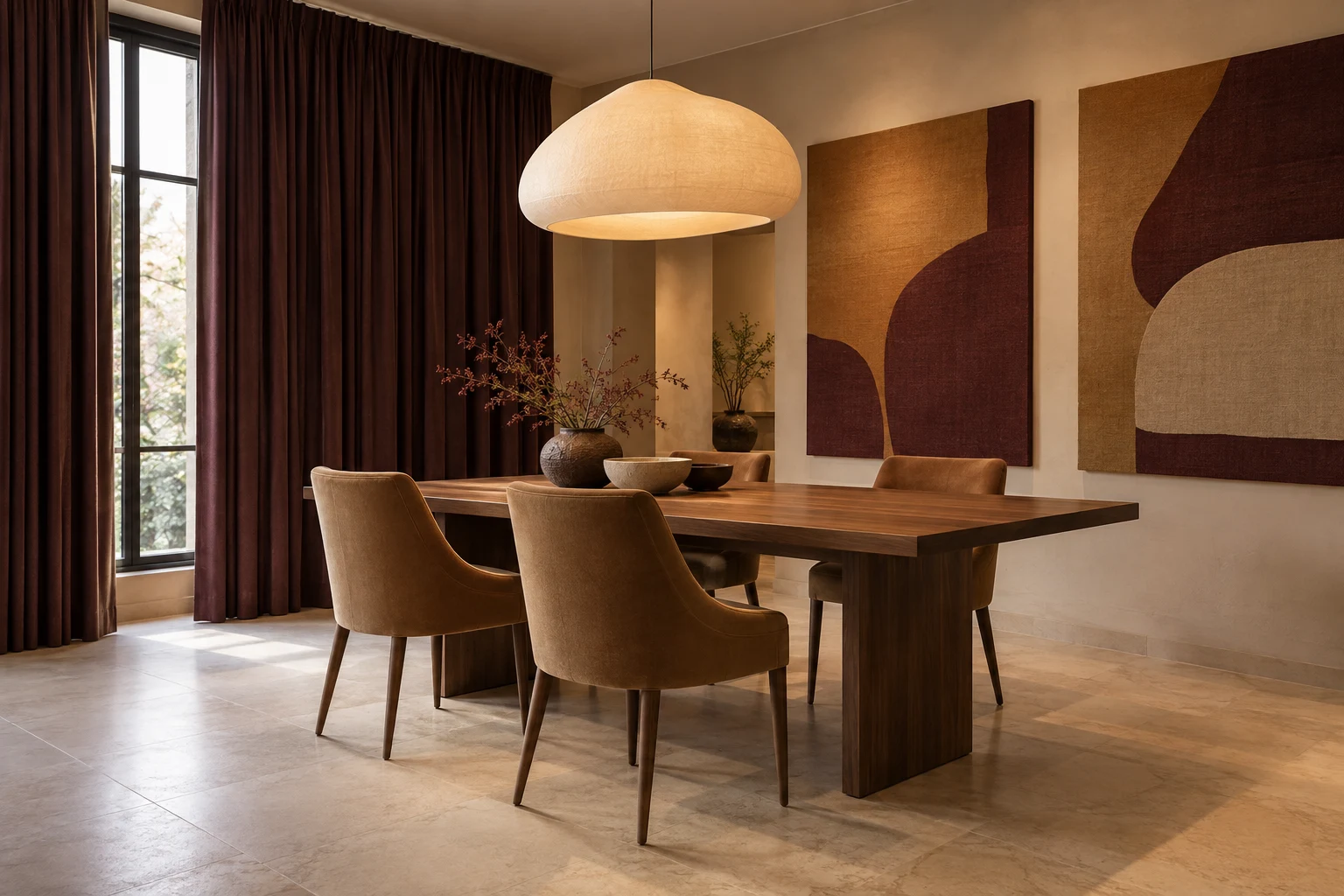
Dining room concept with plum curtains, camel upholstered chairs, a walnut table and two abstract fabric wall panels above a bare stone floor
Softness can move upward. Curtains and fabric wall art make a possible direction for a dining room with an easy-clean floor. AI-generated concept, not a tested acoustic design, exact retail products or completed client work.

1. Listen before you decorate

Three noises.
Three different jobs.

A hard floor, glazing and broad bare walls can leave a room with little absorption. But more fabric will not fix every reason dinner feels loud. You may have more than one of these problems.

Room reflections

The room rings after a voice stops

Words seem to hang in the air; overlapping conversation becomes tiring.

Explore absorption inside the room. Begin with existing curtains and soft furnishings, then assess the remaining hard surfaces.

Background sound

The sound has an obvious source

The television, music or dishwasher competes with the people at the table.

Lower or pause optional playback; run the dishwasher after dinner if practical. Keep necessary ventilation operating.

Incoming noise

Noise arrives through the building

Traffic, neighboring music or footsteps remain when the dining room is quiet.

Investigate transmission through the building. Decorative absorption alone is not a sound-isolation plan.

Acoustic treatment changes sound within a room; sound isolation addresses transmission between spaces. GIK distinguishes these jobs in its treatment and soundproofing guidance. This feature focuses on the first.

2. A free two-evening comparison

Same seats.
Same conversation.
One change.

This is an everyday preference check, not an acoustic measurement or a test of hearing.

  1. Make the baseline fair.

    Choose a normal mealtime with the same small group. Turn off optional music and television. Keep necessary fans and ventilation in their normal mode. Note whether appliances are running.

  2. Listen from the seats people use.

    Have one person read a short paragraph at a comfortable voice level. Listen from the near seat, far seat and seat closest to the kitchen. Note lingering sound, competing sound and how often someone wants a sentence repeated.

  3. Change one reversible thing.

    Close existing curtains first. If there are none, try an existing suitable rug or move an upholstered chair into the room without blocking circulation. Keep exits, heaters and cooking areas clear; do not hang loose blankets over fixtures.

  4. Repeat, then keep only what helps.

    Use the same paragraph, seats, group and appliance conditions the next evening. Ask each person whether listening felt easier, unchanged or harder. If closing curtains helps but loses wanted daylight, you now have a specific trade-off to solve.

Your three-seat noteNear seat: easier / same / harderFar seat: easier / same / harderKitchen-side seat: easier / same / harder

Record the change and conditions beside each answer. No universal score or promised decibel reduction is implied.

3. Choose the surface you can live with

A softer room still has to work at breakfast.

Keep the table and chairs if they serve you. Let cleaning, movement, daylight and installation decide the next step.

Possible next steps and the compromise each brings
OptionUseful first moveTrade-off
Existing curtainsClose them during a seated comparison; keep folds rather than pulling the fabric flat.Privacy and daylight change. A curtain’s appearance does not establish acoustic performance.
A suitable rug you already ownTry it only if the complete chair movement and cleaning routine work.Crumbs, spills, edges and rolling or mobility needs can make a rug the wrong solution.
Acoustic art or fabric panelsConsider documented absorption on available wall area when a bare floor matters.Mounting, depth, cleanability and custom-order terms need checking. Ordinary framed art is not equivalent.
A ceiling treatmentConsider professional assessment if wall space is scarce or the room is tall and open.Installation and coordination with lighting, services and the building make this a larger project.

On a narrow screen, scroll the comparison sideways. For a rug trial, use our furniture-aware rug guide; a smaller rug is not a bargain if chair legs keep catching its edge.

4. Worked example / A proposed plan, not measured results

The floor stays bare.
The walls earn a second job.

Imagine an enclosed 12 × 14-foot dining room with a stone floor, walnut table, four upholstered chairs, a large window with existing curtains and an empty wall. The household wants easy crumb cleanup and prefers not to add a rug.

Keep / Test / Consider

Keep
The floor, table and chairs.
Test
Closed curtains during dinner; optional background music off.
Consider only if needed
Two fabric acoustic art panels on the available wall.

Turn a shopping idea into a specific brief.

If the curtain comparison helps but conversation still feels tiring, send a supplier the room dimensions, ceiling height, photos, openings and intended seat positions. Ask whether the proposed wall is useful and how much treatment they recommend.

Two nominal 24 × 48-inch panels have a combined face area of 16 square feet: 2 × (24 ÷ 12) × (48 ÷ 12). That is a way to understand the proposal’s scale, not proof that two panels are enough. Confirm actual finished dimensions, depth and mounting before marking the wall.

Paper templates can help you judge visual size and chair clearance; they cannot preview acoustic performance. Obtain a complete quote including hardware, artwork, delivery and installation before deciding.

The creative move

A listening diptych.

Use two related original abstract images across the acoustic panels: one in plum and one in ochre, connected by a narrow cream line. Repeat one color in the existing table linen. Ask the maker to print on its approved acoustically transparent fabric; do not cover the finished panels with glass or improvise paint over their faces.

This creates a visual focal point with a potential acoustic role, while keeping the floor available for everyday cleanup. Follow the maker’s exact finishing and installation instructions.

5. Two research starting points

Buy the documented function,
then choose the finish.

These official listings illustrate different specification conversations. Neither is a promise of a particular result in your room.

When wall art can do more

GIK Acoustic Art Panels

The U.S. page offers custom printed artwork, several thicknesses and nominal 24 × 48-inch sizing. Ask for the absorption report for your selected configuration and a room-specific quantity recommendation. Check mounting loads and custom-order return terms.

Explore the official GIK listing

When daylight is part of the brief

Kvadrat Noon curtain textile

Noon is described as transparent, with subtle vertical stripes when hung. Its page lists a sound-absorption download. Ask the supplier for that report and the tested draping and spacing before specifying it; transparency, privacy and absorption are separate decisions. This is fabric specification, not a ready-made curtain order.

Explore the official Kvadrat listing

Listings checked September 29, 2026. Ordinary non-affiliate links; no sponsorship, brand relationship or hands-on testing is claimed. No price or stock promise is made. The accessible Noon page listed an acoustic report, but we could not retrieve the report and have not assigned it a performance rating.

Know when to change course

More softness is not always the answer.

A large open-plan space includes the connected kitchen and living area in its sound environment. Treating one small dining wall may have limited impact. Tall rooms, severe persistent reverberation and substantial incoming noise deserve assessment before a large purchase.

If the main problem is one person’s listening comfort, involve them in the seating and sound choices. Do not treat a decorating plan as a hearing solution or make background audio compulsory. Sometimes a smaller gathering or a different seat is the better immediate choice.

For renters, confirm mounting permission. Keep panels and fabric clear of heat sources and follow product fixing and cleaning instructions. A commercial fire-test label alone does not approve a particular installation.

Before ordering

Five questions that keep the purchase honest.

  1. Am I treating reflections, a noisy source or sound arriving from elsewhere?
  2. Did the no-purchase comparison improve real conversation?
  3. Does the exact product have relevant performance data and installation instructions?
  4. Can I live with its cleaning, light, wall-depth and movement trade-offs?
  5. Do I know the complete cost and the remedy if the proposal is unsuitable?

Sources & editorial notes

Primary sources checked September 29, 2026. The listening comparison, proposed room and diptych are original editorial planning ideas; they are not laboratory tests or a universal acoustic specification.

  1. GIK Acoustics: treatment versus soundproofing — distinction between room acoustics and isolation.
  2. Armstrong: ceiling performance FAQs — definitions of NRC and transmission ratings; commercial technical context, not a residential design prescription.
  3. GIK Acoustic Art Panels — current sizes, thickness choices and custom artwork process.
  4. Kvadrat Noon — transparency, textile description and listed technical resources. Acoustic report not retrieved.

Read our editorial standards · Relevant brand partnership inquiries