
01 / Clear signal
A broad, high-contrast stripe is easy to notice. Give a strong existing pattern room to be itself.
The textile edit / Keep what you love
By Christina Hines ·
Keep one textile as the starting point, connect the other through a color already in the room, and compare how strongly each reads from your usual seat. Different motif sizes can help, but contrast and the amount on view matter too. You do not need to replace a good rug simply because the curtains also have a pattern.
I would first remove optional patterned accessories from the view for an evening. If the rug and curtains then feel comfortable together, the answer may be fewer competing accents, not new textiles.
Try the three-card pattern audition ↓An original visual exercise
These schematic swatches share plum and cream. They demonstrate choices to compare, not actual fabrics or a formula for every room.
A broad, high-contrast stripe is easy to notice. Give a strong existing pattern room to be itself.
A small repeated mark changes the scale. Check whether it still looks busy from across the room.
A plain or subtle texture offers another option. Pattern is an invitation, not a requirement.
The labels describe this drawing. They are not measured ratings, product specifications or universal rules about sensory comfort.
Brentwood Open Learning College’s interior-design teaching material distinguishes scale, the size of a motif, from density, how closely the motifs fill the background. That distinction is useful: a large flower with open space around it is not the same visual proposition as a tightly packed floral.
My additional check is the whole view. A cushion sample and a curtain sample may seem equally important on a desk, although the finished curtain occupies much more of the room. Look at the pieces where you will actually use them rather than treating a tidy sample board as the final decision.
Do not leave fabric over a lamp or heater as a mock-up. For a future curtain, ask for a sample you can safely hold at the window in daylight and under the lighting you normally use.
Worked example / No replacement rug
Imagine a cream sofa, a navy-and-rust patterned rug, navy striped curtains and three floral cushions. The room feels crowded when the curtains close. The owner initially plans to buy a plain rug.
The rug fits, feels good underfoot and is already owned. It stays. No new rug cost is needed for this experiment.
Store the floral cushions for one evening. Try the existing plain cream cushions instead, leaving the rug and curtains as the only prominent textiles.
If the closed-curtain view still feels too strong, audition a lower-contrast curtain sample before ordering. If it works, stop at the free edit.
This is a hypothetical decision path, not a completed client project or a claimed test result. The useful result is a specific next choice, including the choice to buy nothing.
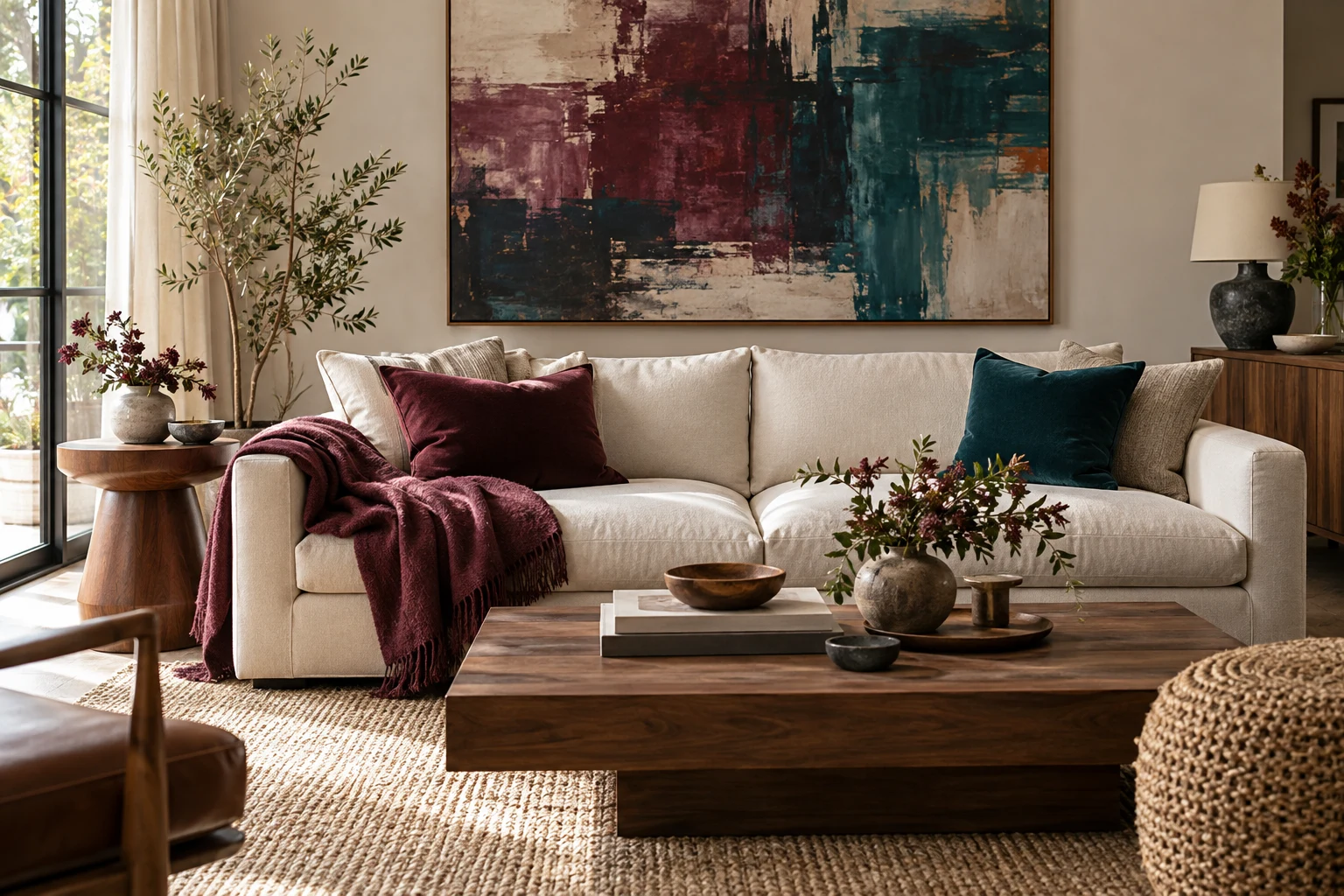
Instead of pulling the brightest flower or stripe color into another object, try repeating the pattern’s background color in a plain cushion or an existing throw. In a cream-ground rug with plum motifs, cream can connect the sofa to the rug without adding another plum statement. This can be especially useful when the art already supplies the accent.
Start with your own textiles. If a purchase remains useful, compare physical samples from the intended supplier, then request the finished dimensions, composition, care instructions, lining options, pattern placement and total made-up cost. Confirm return terms before ordering custom work. Use the curtain measurement guide for the next step, not a guess based on the sample size.
Spiffy Spools’ fabric sample collection is one verified place to browse plain, floral, geometric and striped options. This is a sample-resource link, not a recommendation of a particular fabric, price or stock position. Ask the supplier whether the sample shows the full repeat. No purchase is needed to complete the free edit above.
If you enjoy a dense, layered room, you do not need to quiet it for a formula. If pattern is uncomfortable for someone using the space, a plain choice may be preferable even when a mix looks coordinated. Privacy, light control, accessible movement and workable cleaning needs take priority over styling. This exercise does not establish blackout performance, durability or suitability for upholstery; those require the exact product’s specifications.
Continue with Material Matchmaker, the rug-size guide and adding color around an existing sofa.
Checked October 26, 2026. The scale-and-density distinction is informed by Brentwood Open Learning College, Design Elements, Unit 3. The supplier sample collection was checked as an optional resource. The audition, free edit and example are original editorial suggestions. I have not tested these fabrics; these are ordinary non-affiliate links with no paid placement.