
Everything blends together.
Try one accent with a noticeably different depth. A dark berry throw against cream can create a focal point without painting the entire room.
The considered refresh / No. 01
How do you add color without replacing your sofa?
Start with the upholstery you already own, choose one expressive accent, and repeat it deliberately in the room. Test the combination in your actual light before buying. A new atmosphere does not require a new room.
Find a direction for your sofa ↓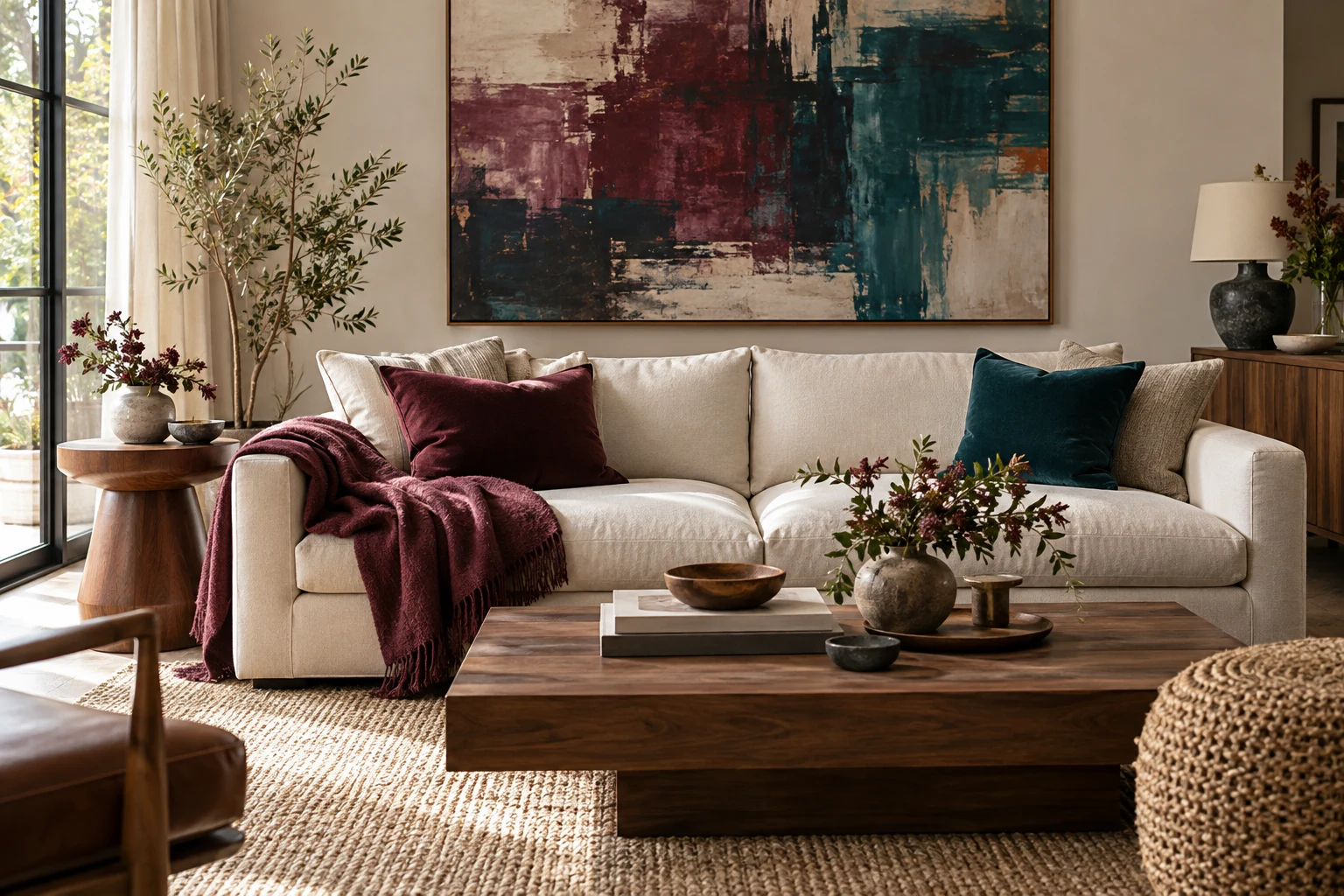
First, find the real problem
A room can contain beautiful pieces that never quite relate. Adding more objects may make that feeling stronger. Stand at the doorway and identify which of these situations sounds familiar.
Try one accent with a noticeably different depth. A dark berry throw against cream can create a focal point without painting the entire room.
Temporarily put away the newest accessories. Pull one hue from a rug or artwork you love and repeat it in a different material.
Check the room under the lighting you normally use. A color purchase may not solve a lighting mismatch. Compare samples with your lamps on before committing.
Three starting points / Make them your own
These are our illustrative combinations, not rules or paint matches. The swatches help you compare relationships; real fabrics, finishes and screens will vary.
Try this when your sofa reads cream, oatmeal or warm beige.
Keep the sofa and the largest neutral surfaces. Introduce mulberry in one substantial textile, then echo a little teal from an artwork in a cushion or object. Existing walnut furniture can supply the connecting warmth.
If your cream looks distinctly yellow next to the samples, test a softer berry and a less blue teal. Do not order from the screen alone.
Try this when your gray sofa feels cool beside the floor or walls.
Give cobalt one clear role: a print, a throw or a single chair if you actually need seating. Use muted apricot in a smaller textile to introduce warmth, and repeat an existing dark frame or table rather than adding another finish.
If the gray reads purple or green, test with the fabric in person. If the room already has busy art or a patterned rug, borrow an existing accent instead of introducing two more.
Try this with chocolate upholstery or warm brown leather.
Use cornflower blue as a fresh contrast in artwork or a textile. Bring in chalk through an existing light rug or curtain, then keep olive as a restrained connection to plants or a favorite object. Let the brown remain the anchor.
A reddish brown and a nearly black brown can need different blues. Compare the exact samples beside your sofa, not a photograph of a similar one.
The sample test
Natural and artificial light affect color appearance. Benjamin Moore recommends evaluating samples in different lighting conditions; Sherwin-Williams explains why undertones can shift the impression of a neutral. Our practical sequence:
A worked example / Keep the investment focused
Imagine a cream sofa, an existing walnut table and plain curtains. The aim is a berry-and-teal accent story. These are planning allowances, not researched product prices or a promise that every retailer can meet them.
| Use | Allowance | Decision |
|---|---|---|
| Two cushion covers | $70 | Reuse inserts only if the dimensions work. |
| One substantial throw | $80 | Choose the accent you want to notice first. |
| Art or framing | $100 | Start with art you own; unused funds can stay unspent. |
| Tax, delivery or sample buffer | $50 | Confirm the checkout total before buying. |
| Total limit | $300 | Keep sofa, table, rug and curtains. |
If the actual costs exceed the allowance, postpone a category. Buying fewer coherent pieces is a valid finished result.
Before you shop
A throw brings a broad area of color. A cushion cover gives a smaller repeat. Art can connect multiple shades. Choose the role first, then compare products.
Explore Benjamin Moore’s sampling options ↗
This is an ordinary manufacturer link, not an affiliate link or a claim of brand partnership.
The details people ask about
Start with portable textiles, existing freestanding furniture and art. Check your lease before painting or fixing anything to a wall; “removable” products can still affect finishes.
No. A useful hierarchy matters more than a percentage. Let the sofa and fixed finishes provide a base, give one accent a leading role, and use any other colors to support it.
Use its color as the starting accent. Repeat a related shade in one other place, then test a quieter supporting neutral. You do not need to introduce a new bright color.
They can share a repeated material or small accent without using identical palettes. Compare samples from the connecting sight lines before making a large purchase.
Reviewed September 24, 2026. Color recipes and budget allocation are original editorial examples. Technical guidance on sample testing and undertones draws on Benjamin Moore’s color-selection guidance and Sherwin-Williams’ undertone explanation. We have not tested particular products for this feature. How we select and explain recommendations.