
01ArriveThe doorway
What greets you twice?
Keep a composed wall, an artwork or a calm slice of window. Notice laundry, doorways and work surfaces before choosing the frame.
The reflection edit / A second view, considered
Put it where its reflection is useful from the places you actually occupy—not simply where the frame fits. Start with the doorway, your most-used seat and the room after dark. Keep a view you enjoy, remove a distracting reflected object before moving the mirror, and choose art instead if every workable position repeats clutter, glare or a private space.
Run the three-view audition ↓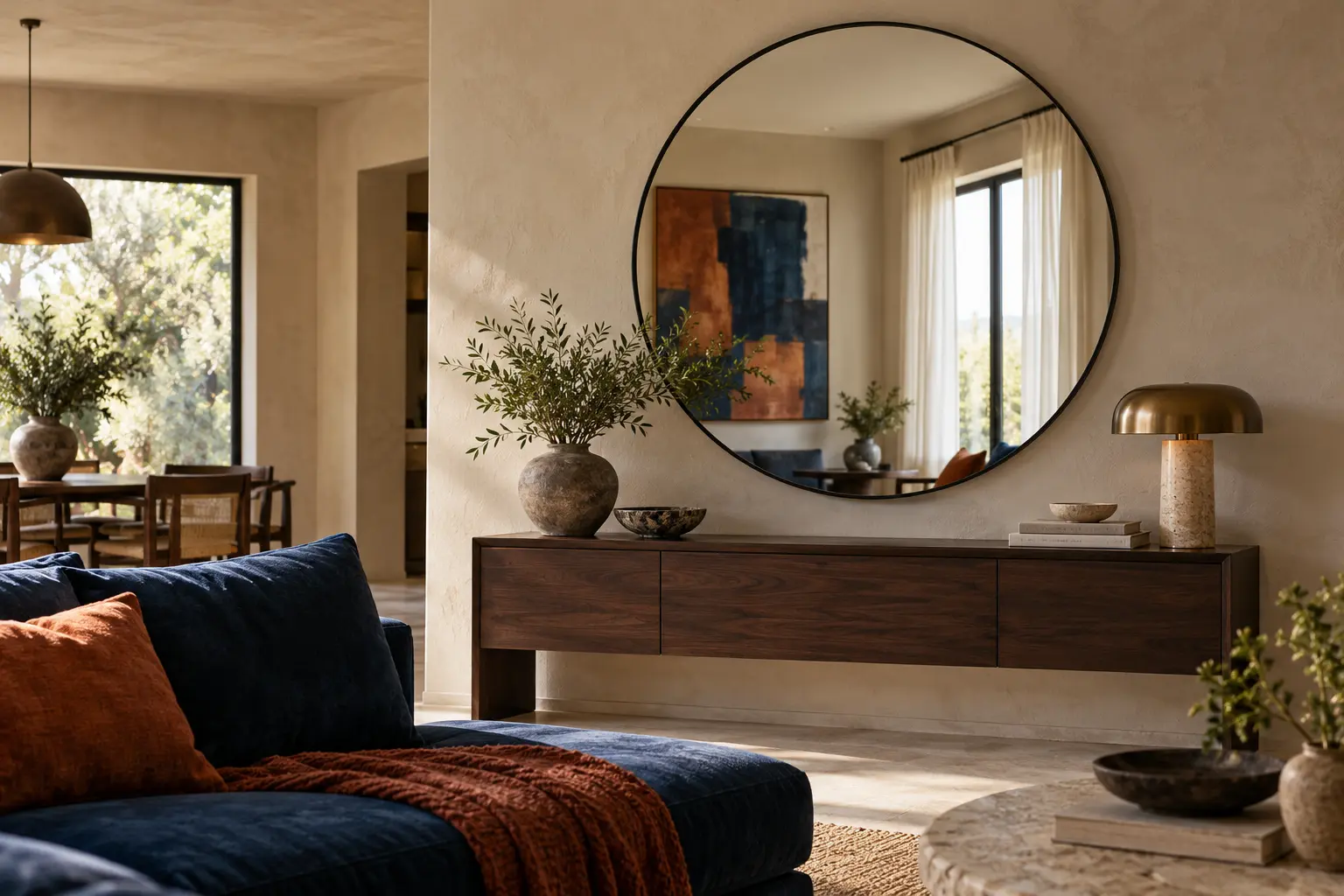
Diagnose before you decorate
A mirror has two compositions: its frame on the wall and the scene inside it. A beautifully centered frame can borrow the busiest part of the room. A large mirror can also repeat a lamp, a screen or a stack of papers you barely noticed in the direct view.
The optical reason is straightforward: OpenStax explains that a plane mirror obeys equal incoming and outgoing reflection angles. Our design inference is that the reflected scene changes with the observer’s position. There is no single mounting height that produces the best decorative view for every seat and household.
Umbra’s placement guide suggests trying a mirror opposite or beside a window. Treat that as a candidate, not a guarantee: check the view and brightness at the hours you use the room. A mirror reflects existing light; it does not replace lighting or create floor space.
The original three-view audition
Make a small contact sheet: three phone photos of the existing mirror, taken from normal eye positions. Under each, write one thing to keep and one thing to remove. Keep the camera position consistent when comparing changes.
Keep a composed wall, an artwork or a calm slice of window. Notice laundry, doorways and work surfaces before choosing the frame.
Sit at your actual eye height. A standing-up success can become a reflection of a ceiling fixture, a screen or someone’s private workspace.
Use the normal evening lamps and window coverings. Check for a bright source in the reflection and for views that reveal more than you intended.
The stop rule: do not trade a comfortable everyday seat or someone’s privacy for a better doorway photograph.
Before drilling, identify the wall construction, mirror weight, approved orientation and specified hardware. Follow the exact mirror’s instructions and lease rules; have a suitable installer resolve uncertainty. This is a placement exercise, not a mounting specification. Never improvise an angle by loosening wall fixings.
Worked example / A 12 × 15-foot living room
Illustrative scenario, not a client result: a renter has a securely mounted 30-inch round mirror above a 48-inch console. From the entrance it reflects a pleasant window. From the sofa it repeats an open shelf piled with paperwork. At night a portable lamp appears as a bright spot.
The renter files the papers in existing storage and moves the lamp to another suitable surface within safe cord reach. The mirror remains fixed. Three new photos show the window at arrival, books and a single artwork from the sofa, and no bright lamp reflection from that seat.
Cost of the first attempt: $0. No new frame, glass or mounting holes. If the lamp cannot move safely or the shelf needs to stay busy, the next decision is a different mirror location or a non-reflective wall piece—not more styling accessories.
| What you notice | Free first move | The decision |
|---|---|---|
| The reflection is cluttered | Move the reflected objects first | Keep the mirror if an ordinary daily reset—not constant staging—solves it |
| A lamp is bright in the reflection | Try a safe lamp-position change without stretching its cord | Move the mirror or choose art if the reflected source remains uncomfortable |
| It looks good only from the doorway | Give the most-used seat priority | Accept a less dramatic entrance if the room is better to live in |
| The wall is balanced but the reflection feels busy | Test a narrower reflected field | Compare a smaller mirror or an approved vertical orientation; bigger is not automatically better |
| The view exposes a bed, desk or neighboring window | Check from every relevant approach | Choose another wall or a non-reflective piece if privacy cannot be preserved |
| There is no view worth repeating | Leave the wall quiet for a week | Use existing art, a textile or nothing; a mirror is optional |
Compare the actual outer dimensions with a full-size paper outline, then compare the reflected field. A horizontal shape can include more of a busy scene; a vertical one may suit a narrower view. Neither orientation is universally calmer. Only rotate a mirror when the manufacturer permits that mounting orientation.
Umbra Hub Oval Wall Mirror, black, 24 × 36 inches, SKU 1006044-040 is a useful specification reference: the official US listing describes a rubber rim and permits horizontal or vertical hanging. On October 19, 2026, the page showed it as unavailable/backordered. It is not an immediate-purchase recommendation. If considering it later, recheck availability, the selected size, installation instructions and suitability for your wall.
Ordinary non-affiliate link; independently selected, not sponsored or hands-on tested. The room concept does not depict this product. No purchase is needed to complete the audit.
A bathroom, dressing area or accessible personal-care setup must prioritize the actual users’ view and reach; do not sacrifice function for a decorative reflection. Moisture suitability, electrical clearances, large architectural mirror panels and mounting above sleeping or seating areas need product-specific assessment. This guide does not cover magnifying or curved mirrors, structural installation, or code compliance.
Some people find reflected motion or seeing themselves in a resting space distracting. In that case, a quieter wall may be the better answer. A mirror is not a compulsory finishing layer.
Primary sources checked October 19, 2026. The three-view audition, borrowed diptych and worked room are original editorial planning methods, not measured performance claims.