
Fixed field
The room’s baseline
Flooring, cabinetry or substantial millwork. Read its warmth and grain, then let it lead by area.
The wood map / A material decision
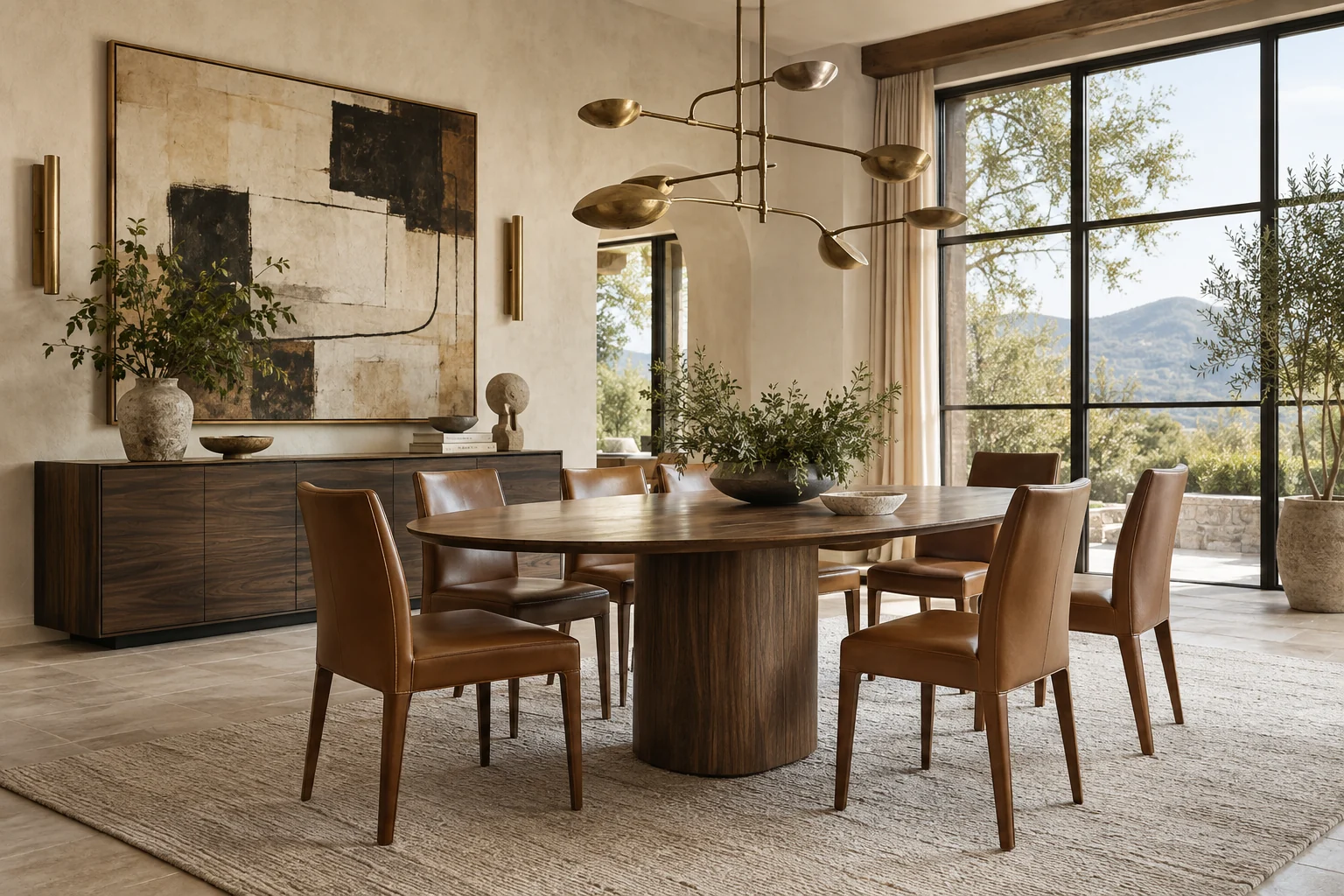
Do not try to match every brown. Name the wood you cannot change, choose one main furniture tone, and let a third element bridge their warmth or darkness. A room usually feels busy when too many woods have equal visual weight—not simply because the species are different.
1 / The free first edit
Before buying or refinishing anything, take small wood-look trays, frames, boxes and decorative objects out of the room. Photograph the simplified space in daylight. Those accessories often create more noise than the floor, table or cabinet you thought was the problem.
If the room already feels calmer, stop. The least expensive solution may be fewer small wood notes, not a new large piece.
2 / The three-role wood map
These roles are about visual weight, not a rigid maximum of three species. More woods can work when their hierarchy stays legible.
Fixed field
Flooring, cabinetry or substantial millwork. Read its warmth and grain, then let it lead by area.
Anchor
One table, bed, console or case piece. It may contrast, but it should look chosen against the fixed field.
Bridge
Repeat the anchor’s darkness, the floor’s warmth, or both—often through leather, bronze, woven fiber or art instead of another wood.
3 / Compare the actual relationship
Use this table after the free edit. It is a decision aid, not a claim that one species always behaves or looks the same.
| Relationship | Example | Best next move | Visual risk |
|---|---|---|---|
| Same warmth / different depth | honey oak + deep walnut | Let the lighter wood cover more area; repeat the darker note once or twice. | Low |
| Similar depth / different warmth | yellow oak + red mahogany | Separate them with linen, stone, paint or metal so the undertone shift looks deliberate. | Medium |
| Strong grain / strong grain | cathedral-grain oak + figured walnut | Give the patterns distance and keep nearby upholstery, rugs and objects quieter. | Medium |
| Three warm reddish stains | cherry + red oak + mahogany | Edit the smallest wood accessories first; do not add a fourth finish to repair the mix. | High |
A worked example / Illustrative, not a client project
The existing honey-oak floor covers the most area. A wanted walnut table brings a deeper, neutral-brown anchor. The blackened-oak chairs introduce a third wood but read almost as a dark line rather than another mid-brown block.
If the chairs were another medium reddish-brown with energetic grain, this example would lose its hierarchy. The fix would be to simplify the chair finish or create more separation—not to find an exact stain match.
4 / The listing translator
Read “walnut,” “oak” and similar words in context. They can describe a species, a veneer, a stain color or merely the finish name. Construction affects appearance, care, repair and what refinishing may be possible.
Walnut
Rejuvenation’s Wallace Nightstand listing says the piece is crafted of solid walnut or ash and finished with veneers. That is a construction description, not just a color name.
See the official listing ↗Dark Walnut
PB Teen’s Hampton Canopy Bed lists a Dark Walnut finish but describes construction from eucalyptus, plywood and MDF. The name does not mean the bed is solid walnut.
See the official listing ↗When this advice does not apply
Do not sand, strip or stain an heirloom, a rental fixture, factory-finished veneer, laminate, or any piece whose construction you cannot identify. A color problem is not permission to damage a surface.
Minwax notes that final stain color depends on the stain, the wood species and porosity, and how long stain remains before wiping. Its guidance recommends testing in an inconspicuous area; natural wood also varies within a species. Follow the exact finish manufacturer’s directions, and involve a qualified furniture conservator or finisher when value, age or veneer is uncertain.
If a fixed orange or red floor overwhelms every sample, paint, rugs, upholstery and lighting may provide a safer bridge than altering the floor. If the finish is failing rather than merely mismatched, diagnose that separate maintenance problem first.
The final checkpoint
Primary sources checked September 26, 2026: Minwax on staining interior wood, Minwax wood-finishing basics, the Rejuvenation Wallace Nightstand listing, and the PB Teen Hampton Canopy Bed listing. Manufacturer instructions apply to the identified product or finish, not every wood surface.
The wood map, combination table and worked room are editorial frameworks, not hands-on product tests or client work. Merchant links are ordinary, non-affiliate references; this feature is not sponsored and implies no brand partnership. Products are cited to demonstrate how listings describe material and finish, not as purchase recommendations. Our editorial standards.