
Too many stopping lines
Curtain rods, shelf tops, frame rows and tall cabinet crowns all end at different heights, making the eye repeatedly register the short wall.
The eight-foot edit / Height without demolition
Create fewer, longer vertical lines and fewer visual stops near the ceiling. Start with what you own: quiet the small horizontal clutter, open the window, place one low visual anchor and redirect existing light upward. Rehang curtains or repaint only when a measured test proves that the ceiling line—not poor layout, glare or inadequate task light—is the real problem.
1. Diagnose before decorating
Curtain rods, shelf tops, frame rows and tall cabinet crowns all end at different heights, making the eye repeatedly register the short wall.
A high-contrast edge, glossy imperfections or one glaring center fixture can make the ceiling plane more noticeable than the room below.
Panels stop at the sill or a rod hugs the casing, turning the visible glass into the room's strongest height measurement.
Several thin bookcases, plants and lamps create a picket fence. A room usually needs one or two clear rises, not a vertical object in every corner.
2. The free 20-minute horizontal-line audit
3. The original visual device
Think in a wall elevation, not a shopping list. Anchor the lower third with one calm furniture mass. Rise through one or two uninterrupted verticals. Release the top band by keeping the ceiling line quiet and the light soft.
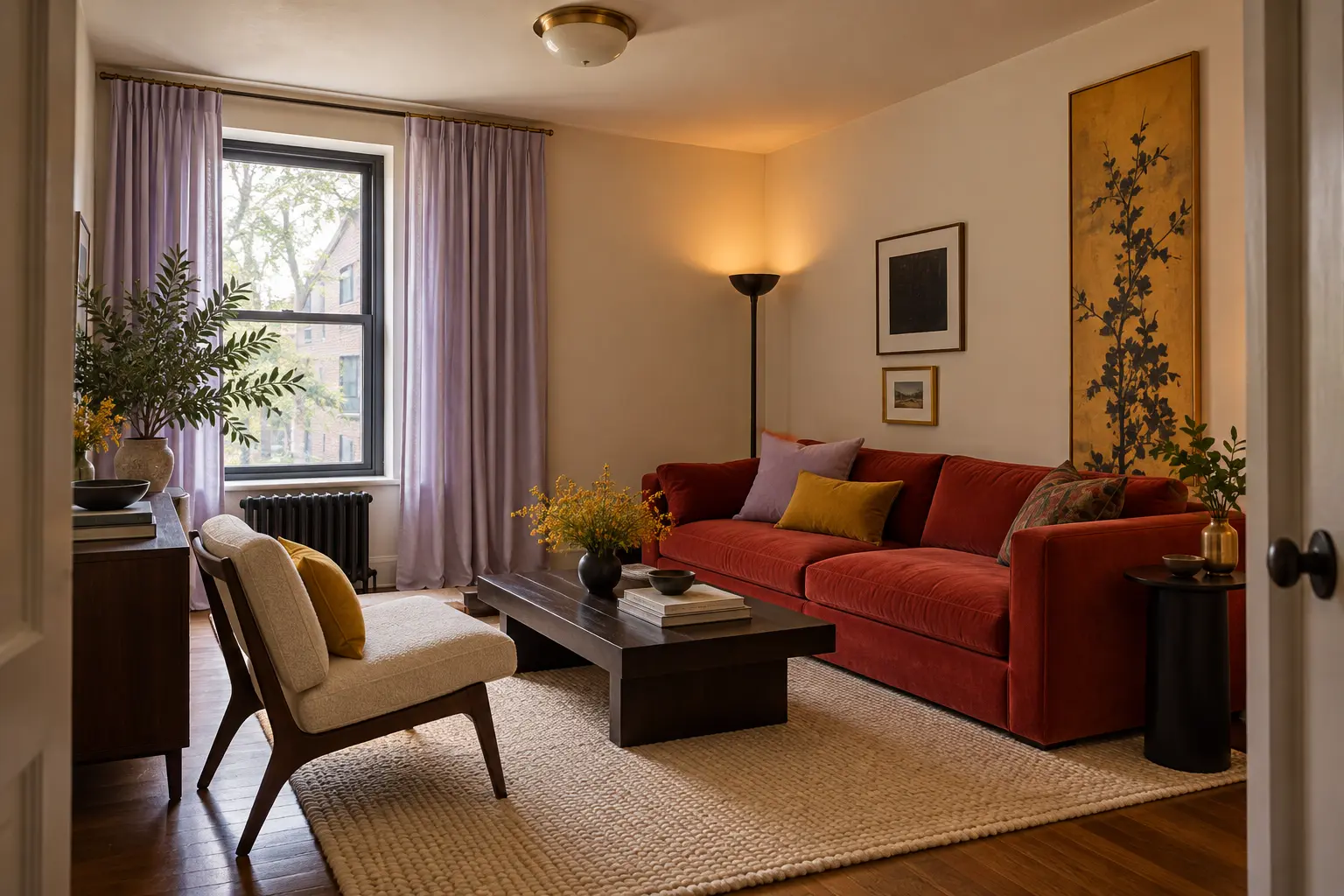
The creative move: make a vertical relay, not a vertical theme. The curtain edge starts the eye's climb, the tall artwork receives it, and the light lets it dissolve before the ceiling. The elements need not match; repeating one accent—tomato, dark cherry or aged brass—makes the relay intentional.
4. Symptom to decision
Each symptom has a no-cost test. A purchase follows only when the same problem survives that test and the exact dimensions work.
| What you see | Try first | Purchase threshold |
|---|---|---|
| The window looks squat | Open the existing panels fully and photograph the complete wall | Rehang high and wide only after measuring the track, stack, panel length and mounting surface |
| The wall has many short horizontal lines | Remove or regroup one small shelf, frame row or cabinet-top display | Add another tall object to compete with the clutter |
| The ceiling edge feels harsh | Test a ceiling color card that shares the wall undertone | Assume bright white works in every exposure |
| The center light makes the ceiling the focal point | Use existing table and floor lamps, then compare the room with the overhead light off | Replace a safe fixture before testing the light layers |
| Tall furniture feels wedged in | Clear its top and give one unit visual breathing room | Buy several narrow towers to create 'verticality' |
| The room feels low only from one seat | Check the seated sight line, shade, valance and art from that exact position | Redesign the whole room around a doorway photograph |
5. Worked example / 12 × 14 feet with an 8-foot ceiling
The room has an 84-inch sofa, a 60-inch-wide window with an 80-inch casing height, an 84-inch curtain rod mounted just above the casing, five small frames, a 71-inch uplighter and a flush ceiling fixture. The ceiling feels lowest from the sofa because the rod, window head, frame rows and lampshades create seven unrelated horizontal stops.
The room dimensions demonstrate a sequence, not a universal hanging height, curtain fullness rule, paint prescription or installation method. Measure finished floor to mounting point in several places; verify track compatibility, panel heading, stack, radiator and vent clearance, wall or ceiling construction and the manufacturer's instructions.
Two exact references, not a required shopping list
A ceiling-track reference
IKEA's U.S. listing gives the cut-to-size rail as 55⅛ inches long and $25, with ceiling fittings included; wall fittings and gliders/hooks are separate. It can support a clean top line, but one rail is not automatically a complete curtain system. Confirm the measured span, every required component, curtain heading, load, substrate, fasteners and installation instructions.
Check current components, dimensions, price and availabilityA low-cost uplight test
IKEA's U.S. listing gives the lamp as 71 inches high with an 8-inch base, a 9-inch shade, a 2-foot-7-inch cord and a $14.99 price. It takes a separately sold E26 bulb up to the listed 13-watt maximum. Tape the base and cord path first, keep the shade out of sight lines, and follow the assembly and bulb guidance.
Check current specifications, instructions, price and availabilityOrdinary non-affiliate links; no sponsorship, paid placement, hands-on test, stock claim or brand relationship is implied. U.S. prices and specifications were checked October 13, 2026 and can change.
When this advice does not apply
You need high-backed support: do not exchange comfort, transfer support or head support for a lower silhouette. Edit the lines around the required furniture instead.
The ceiling has damage, moisture or a new stain: diagnose and repair the cause before disguising contrast or adding light. Decoration is not remediation.
A fan, detector, sprinkler or fixture controls safety: preserve required placement and clearances. Do not aim fabric, art or an uplight into equipment or improvise electrical work.
The room needs strong task light: upward ambient light cannot replace reading, cooking, craft or accessibility lighting. Layer the task source even if it introduces another horizontal.
The ceiling or trim is historically important: contrast may be part of the architecture. Celebrate the detail rather than flattening it for an illusion.
The mounting surface is unknown: ceiling-hung tracks require appropriate support and fasteners. A renter also needs lease approval where required. Use existing hardware if those conditions are unresolved.
The ten-answer height brief
Primary manufacturer and merchant sources checked October 13, 2026. The anchor–rise–release elevation, horizontal-line audit, vertical relay, decision table and worked room are original editorial planning tools. They are not architectural, structural, electrical, fire-safety, painting or installation advice.
Merchant and manufacturer links are ordinary references selected for reader usefulness. No affiliate tracking, sponsorship, paid placement, hands-on testing, audience metric, completed-client work or guaranteed availability is claimed.
Read our editorial standards · Relevant brand partnership inquiries