How Do I Group Houseplants So They Look Intentional and Get Enough Light?
Group plants whose light needs suit the same location, then arrange their foliage so each plant can receive light and be cared for. Repeat one vessel detail to connect the display. A plant belongs where it can grow—not automatically in the corner that needs decoration.
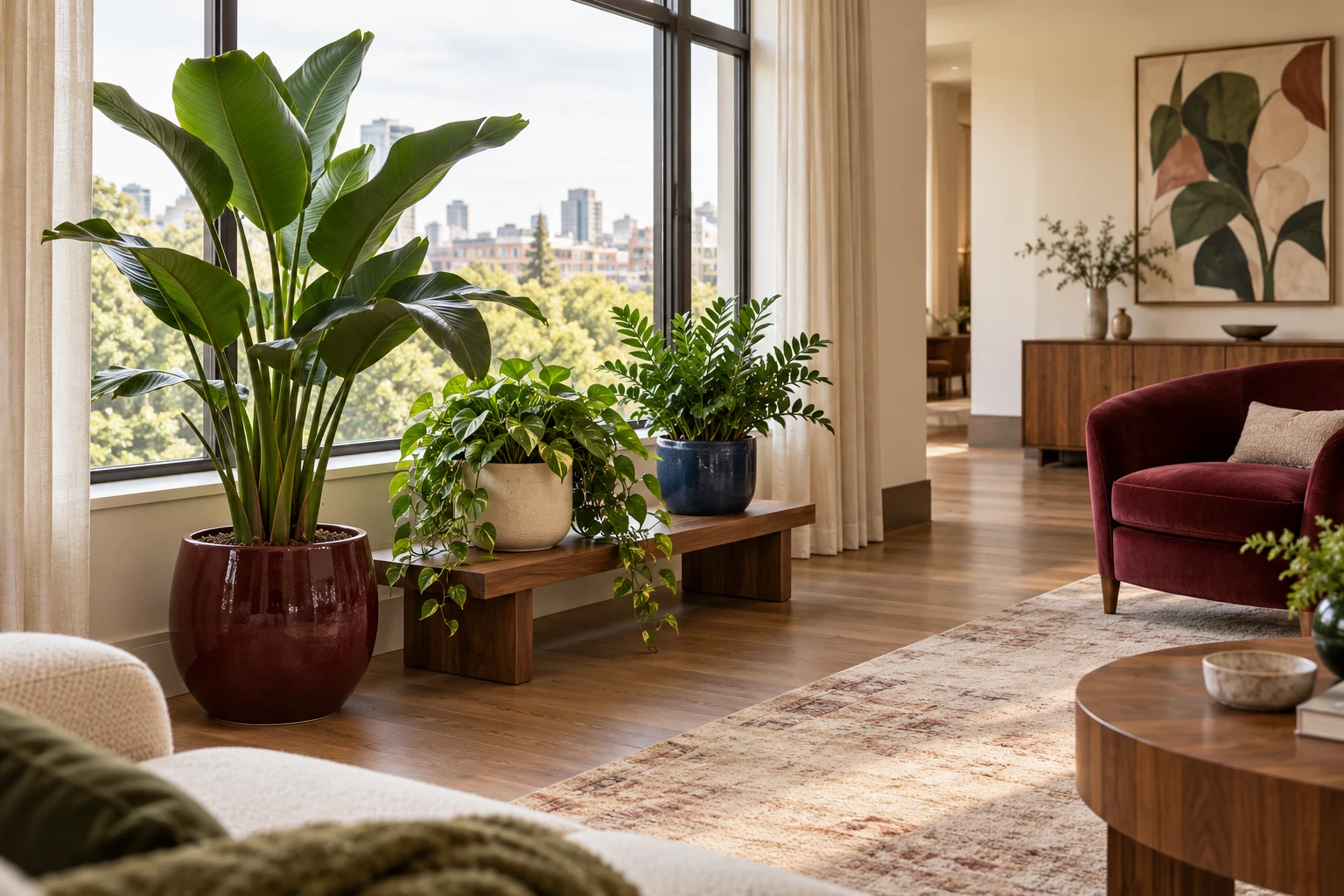
Original AI-generated room concept. It illustrates composition, not a species pairing, measured light level, product or completed client project.
The real problem
A room can look bright while a plant’s position is wrong.
Interior styling often starts with gaps: a tall plant beside the sofa, a trailing plant on a shelf, a small pot on each table. That can spread maintenance across the room and put plants where their growing conditions are an afterthought.
University of Minnesota Extension recommends assessing the quality and duration of natural light before choosing plants. Lower-light tolerance does not necessarily produce dense foliage or flowers, and low light still means some light. Roof overhangs and other obstructions can alter what a window provides.
Start by identifying the plants you own and checking their individual requirements. Keep healthy plants in successful positions unless there is a practical reason to move them. Pots, nearby textiles and art can create visual continuity across separate locations.
A free observation log before you shop
Choose up to three possible locations. Include an existing successful spot and the place you hope to style. Observe at leaf height, not just from the sofa.
Record morning, middle-of-day and late-afternoon conditions. Note direct sun, diffuse daylight or deep shade, plus curtains, nearby buildings and trees. Record the date and weather.
Repeat on a different day if possible. A cloudy day and a clear day tell different stories. These observations are a first screen, not a light measurement or proof that a plant will thrive.
Compare the observations with each plant’s care guidance. If suitability remains unclear, bring the log and plant identity to a knowledgeable nursery or Extension service before buying.
Check the room in use. Open the curtains and window normally, use the nearby seat and walk the usual route. Keep access and required heater clearances intact.
Keep the log after arranging the room. Revisit it as the seasons or window coverings change; a display does not need one permanent position for the whole year.
An original layout device
Compose across the light. Keep the care side open.
This schematic shows the idea from above. It is not to scale and does not model sunlight or prescribe distances from glass.
A / Give the largest silhouette an edge.
A taller plant can anchor one side, provided that position suits it. Avoid using it as a curtain across smaller plants.
B / Offset, rather than stack blindly.
Use a stable surface already available if its load and finish suit the job. Height alone does not prove better light.
C / Let the smallest plant be seen.
Keep it accessible and out of another plant’s shadow. If it cannot fit comfortably, the display can stop at two plants.
The letters describe visual roles, not plant species. Check the light reaching every plant after arranging; foliage growth can change the result.
Make the group feel collected, not crowded.
Choose one connection among the pots: the same quiet color, a similar matte surface or one repeated rim shape. Keep the growing containers separate. The visual relationship does not require identical watering needs or planting everything into a single bowl.
The Royal Horticultural Society’s texture guidance explains how similar foliage textures can create unity and contrasting textures can add emphasis. Use that as a styling tool after establishing suitable conditions. You might pair two fine-textured plants with one broader silhouette, but there is no reason to buy a third plant solely to satisfy an odd-number rule.
Keep separate pots—and separate care decisions.
Illinois Extension notes that species, light, temperature, pot and growing medium all affect watering. Check each plant rather than watering the whole display on one calendar. After top-watering, excess water should drain and the saucer should be emptied; pots should not stand in collected water.
Plan access before styling. You should be able to inspect leaves and remove or empty each saucer without dismantling the group. Use suitable water protection for the surface, check underneath regularly and deal promptly with spills. A decorative pot or plant stand is not a guarantee against leakage or damage to furniture.
Move / connect / leave it alone
What should actually change?
On narrow screens, scroll the table sideways.
What you notice
Try first
The useful decision
The plants look scattered, but are growing well
Keep their successful locations; repeat a pot color or texture
Unify the view without relocating every plant
The proposed group mixes incompatible light needs
Check each plant’s identity and growing guidance
Split the group; connect it through vessels or artwork
A tall plant shades a smaller one
Observe the leaves from the window side
Offset them sideways before adding another tier
The darkest corner looks bare
Try existing botanical art or a sculptural vessel
Leave live plants in suitable conditions
Pots look unified but are awkward to water
Check whether each pot and saucer can be reached independently
Separate containers and preserve a care route
The window is also a door, heater location or busy route
Test normal opening, curtains and circulation
Reduce or relocate the display; do not force a group
Worked apartment example / Hypothetical
Five plants, two suitable locations, one connected view.
BEFORE
Five isolated accents
A 12-by-14-foot living room has five pots: two at an east-facing window, one on a side table, one on a tall shelf and one in a rear corner. The owner is considering a new shelving unit to make the collection look organized.
The room dimensions describe the example only. Window orientation alone does not establish suitable light.
OBSERVE
Sort by conditions
The household records light and checks the exact plants’ requirements. Three are candidates for the existing window area. A fourth remains in a successful spot in another room. The rear-corner plant needs a different suitable location; the owner does not assume a taller shelf will solve the light problem.
AFTER
Keep a smaller group
Three compatible candidates form a loose window-side composition on existing suitable supports, with each pot reachable. Existing cream vessels connect them; a green print moves to the rear wall. The new shelving unit leaves the shopping list.
The fifth plant moves only once an appropriate location is identified. If none exists, the household considers a properly specified grow light, rehoming the plant or keeping fewer plants.
Follow-up is part of the example: monitor the plants over the following weeks and reassess if growth or leaf condition changes. A pleasing photograph is not evidence of horticultural success, and a symptom can have more than one cause.
If a stand solves a measured problem
First ask whether a stand gives the plants suitable positions and keeps your route clear. Measure the complete stand, pot bases, saucers and foliage—not just the number of shelves. Confirm stability, load limits and assembly requirements for the actual arrangement.
One current reference is IKEA OLIVBLAD, black, article 504.866.50: $29.99 on the U.S. listing checked October 22, 2026. It is listed as 22¾ inches high and 17¾ inches in diameter, with three 7½-inch-diameter tops and suitability for indoor/outdoor use. Local stock was not confirmed.
That small top diameter is the useful buying question: will each pot and saucer sit securely on it? Leaves may extend beyond the stand’s base, so its listed diameter is not the whole occupied footprint. Check the exact instructions and load limits before purchase; this is a specification example, not a tested recommendation. Prices and availability can change.
These are ordinary non-affiliate links. No sponsorship, brand relationship or hands-on product testing is claimed.
When to change the approach
No adequate natural light: choose an appropriate grow-light setup based on the exact plant and fixture guidance, or use a nonliving decorative element. A normal room lamp is not automatically an adequate substitute.
Children or pets: verify the exact species’ suitability and keep heavy or unstable containers out of vulnerable routes. A high shelf alone is not a complete safety plan.
Pests or unexplained decline: get plant-care advice before bringing a struggling plant into a close group.
Limited reach or lifting: favor fewer accessible containers and a manageable watering method. Do not build a display that depends on frequent heavy lifting.
Doors, curtains and heating: preserve normal operation and manufacturer-required clearances. Leave the space empty if the display interferes.
Primary sources reviewed October 22, 2026. Horticultural guidance supports light and watering principles; our observation log, layout diagram, decorative echo and apartment example are original editorial planning suggestions. They are not a light survey, species prescription, product test or claim of health or air-quality benefits.