
The corner interrupts no routine
It looks blank in one photograph, but nobody needs to sit, reach, store or pass differently there.
The useful corner / Negative space with a purpose
Assign it one job: pass, support, pause or store. If no real habit or problem points to the corner, let it stay empty. A corner feels intentional when its footprint serves the room around it—not when furniture, plants and baskets merely prove that the floor can hold more.
1. Diagnose the pressure to fill
It looks blank in one photograph, but nobody needs to sit, reach, store or pass differently there.
The floor receives a doorway turn, curtain stack, pet path or access to a window—even when no tape marks the lane.
A basket, plant stand and spare chair collect there because each lacks a better address, not because they work together.
A sofa without a drink surface or desk without supply storage creates a specific need; the corner is only one possible answer.
2. The free 72-hour blank-corner reset
3. The original decision device
Begin with the route, not the object. Each answer ends in one verb. Combining verbs is how a compact corner becomes a chair plus table plus lamp plus basket plus shelf.
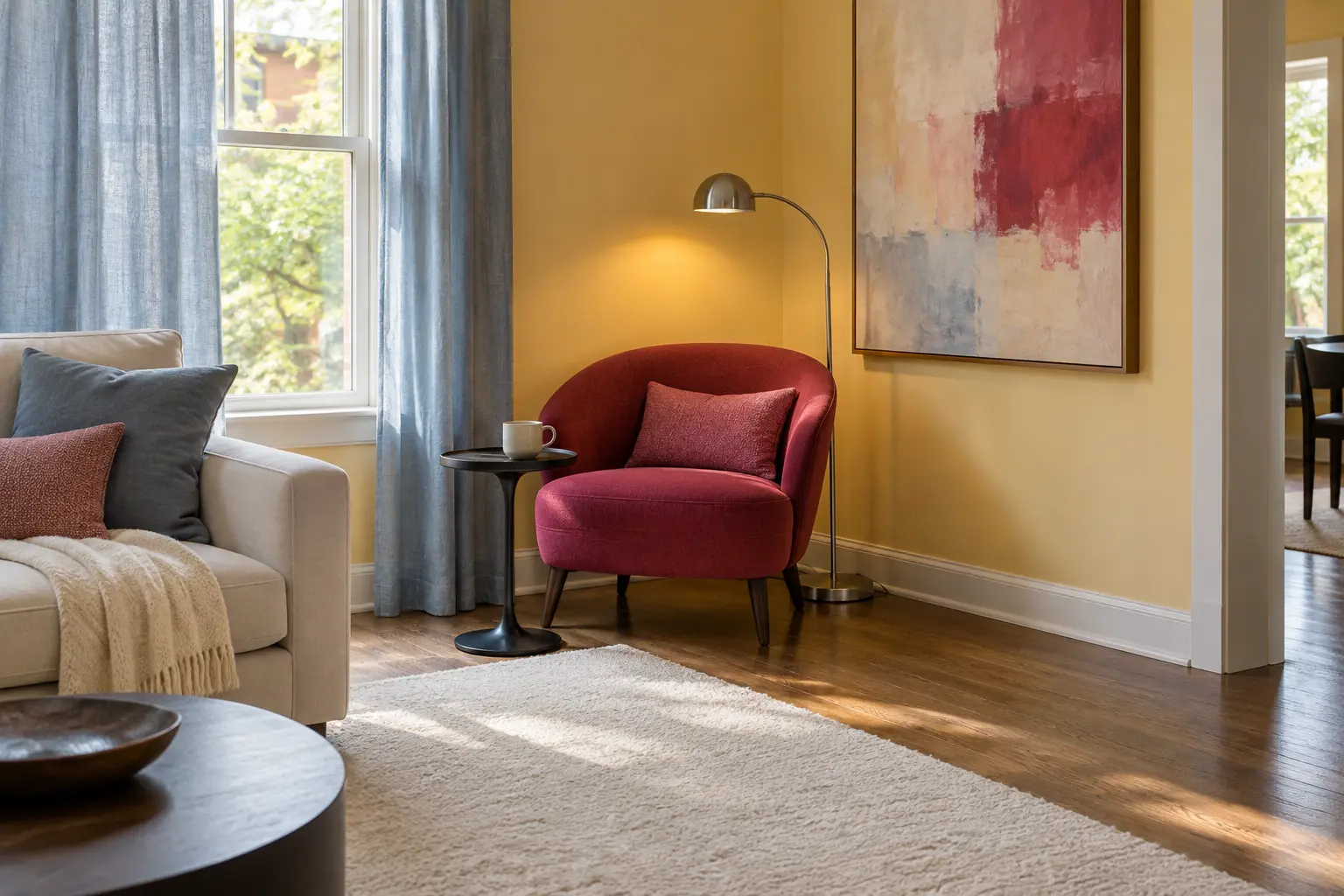
The creative move: style the negative space. Let the wall color, one larger artwork or a light pool make the corner visible without putting another object on the floor. Empty floor can be the composition's quiet shape.
4. Symptom to decision
The object earns its footprint only after a real action names the corner.
| What happens | Verb | Try first | Resist |
|---|---|---|---|
| People cut through the corner | PASS | Remove the obstacle and protect the route | A chair, basket or plant used only to fill the view |
| The nearby sofa lacks a drink surface | SUPPORT | Borrow a stool or small table and test reach for 72 hours | A second seating zone no one requested |
| Someone already stands or sits there | PAUSE | Test an existing chair in its full occupied position | A decorative chair with no comfortable light, reach or exit |
| The same useful items land there daily | STORE | Name the category and cap its volume before choosing storage | Open shelving for unrelated overflow |
| Only the photograph looks blank | EMPTY | Leave the floor clear and strengthen art, color or light elsewhere | A purchase whose only job is hiding negative space |
5. Worked example / 44 × 52-inch living-room corner
A 44-inch-wide by 52-inch-deep corner sits between an 86-inch sofa arm and the opening to the dining room. It currently holds a 25-inch chair, a floor basket and a plant stand. No one sits there; the chair narrows the natural turn, while the person on the sofa sets a mug and phone on the floor.
The worked dimensions explain the method, not a universal clearance or accessibility rule. Measure the actual users, mobility equipment, pet paths, doors, curtains, registers, radiators, outlets, recline, reach and moving parts. A compact object can still be the wrong shape for the turn.
Two exact references, only after the verb survives
SUPPORT / movable surface
IKEA's U.S. listing gives the round table as 15 inches in diameter and 17¾ inches high, with a 30¾-inch total height including its handle, a 22-pound maximum load and a listed price of $44.99. The handle makes it portable but also changes the sightline: tape both the base and full height before deciding that it visually disappears.
Check current dimensions, load, care, price and availabilitySTORE / one capped category
IKEA's U.S. listing gives the black cart as 19⅞ by 11¾ by 32⅝ inches, with four casters, a 15-pound maximum load per shelf and a listed regular price of $29.99. Its shallow depth can suit a supply corner, but three open tiers can multiply visible clutter. Assign one category, tape the moving footprint and verify the care, assembly and use guidance.
Check current dimensions, load, instructions, price and availabilityOrdinary non-affiliate links; no sponsorship, paid placement, hands-on test, stock claim or brand relationship is implied. U.S. prices and specifications were checked October 14, 2026 and can change.
When this advice does not apply
It is part of a route or transfer space: keep the footprint suited to the person and mobility equipment using it. “Looks open” is not a measured access result.
A door, curtain, vent, radiator or access panel uses it: preserve the full operation, airflow and required clearance. Do not disguise maintenance access.
A lamp needs a cord across the path: choose another position. ESFI advises keeping cords out of paths or work areas and away from pinching under doors, windows or heavy furniture.
Storage has doors, drawers or shelves: follow the product's anchoring instructions and confirm the wall and fastener. CPSC's Anchor It campaign advises anchoring furniture with drawers, doors and shelves to help prevent tip-overs.
Children or pets climb, pull or sprint through it: stability, sharp edges, cords, small objects and the actual play route control the decision. A styled corner is not automatically a safe one.
The wall or floor shows dampness, heat damage or a new stain: investigate and repair the cause before covering the area with furniture.
The twelve-answer corner brief
Primary government, safety-organization and merchant sources checked October 14, 2026. The one-corner/one-verb path, 72-hour reset, corner contract, decision table and worked example are original editorial planning tools. They are not accessibility, structural, electrical, fire-safety, product-testing or installation advice.
Merchant and manufacturer links are ordinary references selected for reader usefulness. No affiliate tracking, sponsorship, paid placement, hands-on testing, audience metric, completed-client work or guaranteed availability is claimed.
Read our editorial standards · Relevant brand partnership inquiries