
Lead
Give the dining fixture the strongest silhouette if the table is the gathering point. Its actual light still has to suit the table and its users.
The connected ceiling / A lighting edit
Give each fixture a useful job, choose one visual lead, and repeat one detail across the view. That detail might be a curved shape, a quiet metal finish or an opaque shade. You do not need matching sets, and you do not need to replace working lights just because their finishes differ.
By Christina Hines · October 20, 2026
Build your three-zone score ↓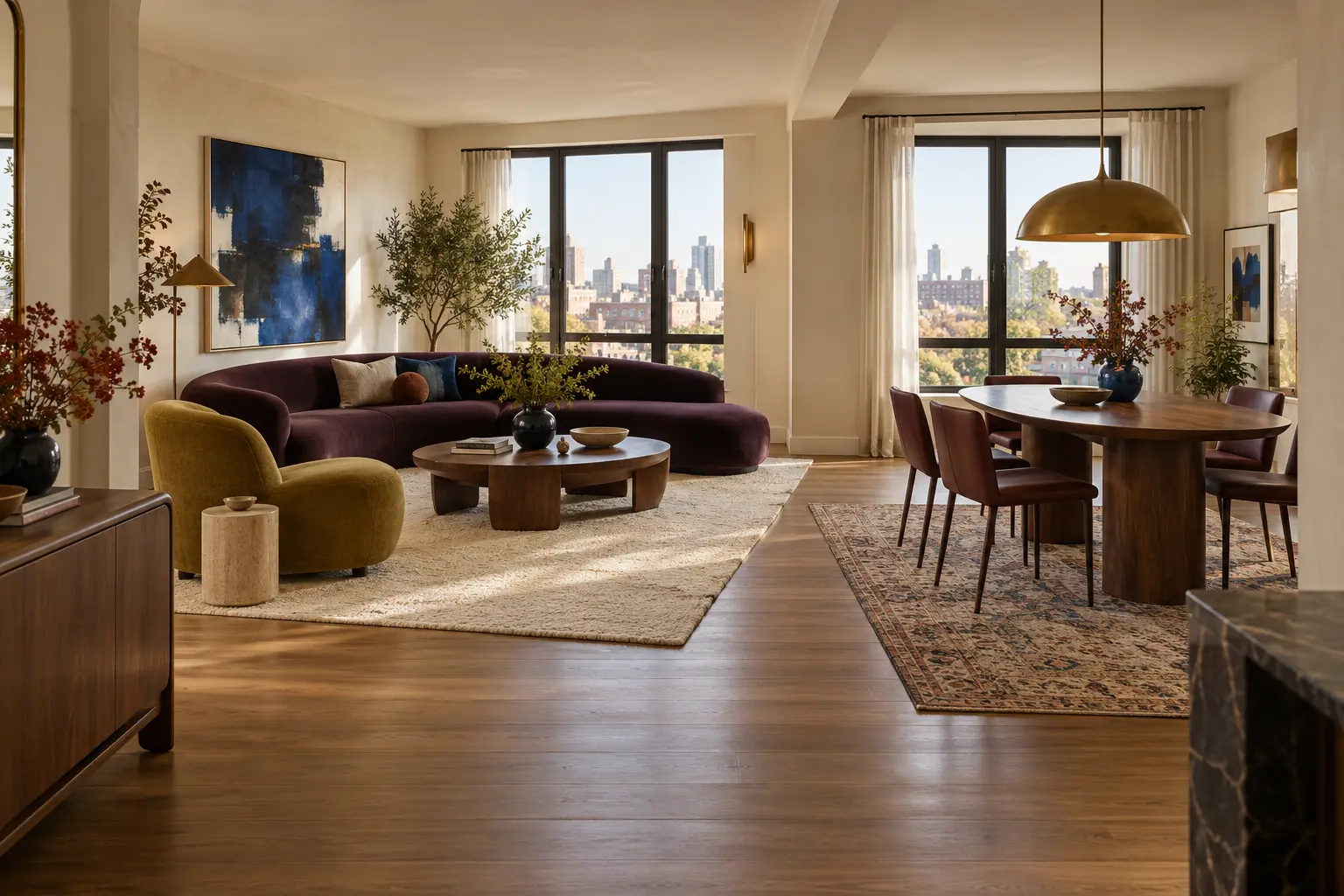
Start with what you own
A ceiling can look coordinated in daylight and feel wrong after dinner. Before blaming brass against nickel, ask whether the discomfort comes from competing shapes, an exposed bright source, or light that looks different from one zone to the next.
Visual Comfort’s planning guidance starts with the function of the light and then considers scale and appearance. Our approach adds a simple visual hierarchy: one fixture can be expressive while the others support daily use. This is an editorial styling method, not an electrical or illumination standard.
Use only existing switches and compatible controls for this audit. Do not disconnect, rewire, cover or modify a fixture to test a look.
An original planning device
Sketch three fixtures side by side as silhouettes. This is a visual score, not a wiring diagram or a scaled lighting plan.
Give the dining fixture the strongest silhouette if the table is the gathering point. Its actual light still has to suit the table and its users.
Repeat one detail, such as a dark stem or rounded edge. A smaller, simpler form can connect the zones without copying the main fixture.
Let a low-profile fixture recede where the ceiling needs breathing room. Confirm clearance and useful output for that location.
One repeated detail is a starting point, not a quota. If all three existing fixtures are quiet and the room works, you do not need to purchase a statement piece.
Illustrative example: a connected kitchen and dining space has black island pendants, an inherited brass dining chandelier and a white passage fixture. The owner assumes that all three must become brass.
From the doorway, the chandelier is already the natural focal point. The pendants have simple stems and the passage fixture visually recedes. The daylight composition needs no replacement. At dinner, however, the island sources look much cooler and brighter than the dining light.
The first step is to record the current bulb and control specifications and test an appropriate, manufacturer-compatible light-source choice—not order a new chandelier. Where bulbs are replaceable, compare the actual light in the room; similar labeled color temperatures are a starting point rather than a promise of identical appearance. Integrated LED fixtures may offer fewer adjustment options.
For the visual connection, keep the black pendants and repeat their dark line with an existing dark bowl on the table. This small echo sits below the ceiling and leaves the inherited chandelier intact. If the light still feels uncomfortable, address the specific source or control with a lighting professional before decorating around it.
| What you notice | Try first | Decision |
|---|---|---|
| Everything competes for attention | Choose the fixture you actually want to notice first | Keep it; let future purchases be visually quieter |
| The metals differ, but the room feels good | Look for a shared shape or shade material | Keep the mix; an exact finish match is optional |
| The room feels disjointed only at night | Compare the sources separately, then together | Check light appearance and brightness before changing fixtures |
| An attractive pendant shines into seated eyes | Check the actual seated view | Prioritize shielding and comfort over the matching finish |
| The island is dark when dining feels comfortable | Identify which source serves the work surface | Seek a task-lighting solution; decorative unity cannot replace usable light |
| The new LED flickers when dimmed | Record bulb, fixture and dimmer model numbers | Verify compatibility with manufacturers before buying another shade |
Save the doorway photo beside the product specification sheet. Ask the seller to answer these questions for the exact model and finish:
Visual Comfort’s ceiling-light catalog is one optional place to compare silhouettes. It is a browsing reference, not a tested shortlist, price claim or partnership. Use the same brief with any retailer.
For controls, Lutron’s Dalia compatibility guidance illustrates why “dimmable LED” alone is insufficient: check the particular bulb and dimmer pairing. Other products have their own requirements. Refer electrical work and fixture support to a qualified installer.
Prioritize visibility, individual sensory preferences and comfortable movement over a photographic hierarchy. A low ceiling, a fan, a sloped ceiling or a movable dining table can change what is practical. In a rental, secure permission before changing hardwired fixtures. Avoid universal hanging-height rules here: the fixture, the space, the people and installation requirements determine the fit.
For the next measurement step, use our chandelier guide or island-pendant guide. For a room that feels disconnected beyond the ceiling, read our open-plan cohesion guide. If brightness is the problem, start with the glare guide.
Reviewed October 20, 2026. Manufacturer guidance supports the functional planning and compatibility points; the three-zone score, audit and example are original editorial suggestions. The example is hypothetical. No hands-on product testing or brand relationship is claimed. The links in this feature are ordinary, non-affiliate references.