
Candidate A / 108 × 70 inches
12-inch ends
15-inch sides
(108 - 84) ÷ 2 = 12
(70 - 40) ÷ 2 = 15
The length may look right while the sides feel too full. Rehearse the 15-inch side drop before ordering.
The gathered table / Fit before fabric
Measure the table in the configuration you will use, choose a comfortable overhang, and check the cloth’s width and length separately. A rectangular cloth can have a short drop at the ends and a much longer one beside the chairs. I would rehearse both with a cloth already in the house before choosing a new size or fabric.
See the two-drop calculation ↓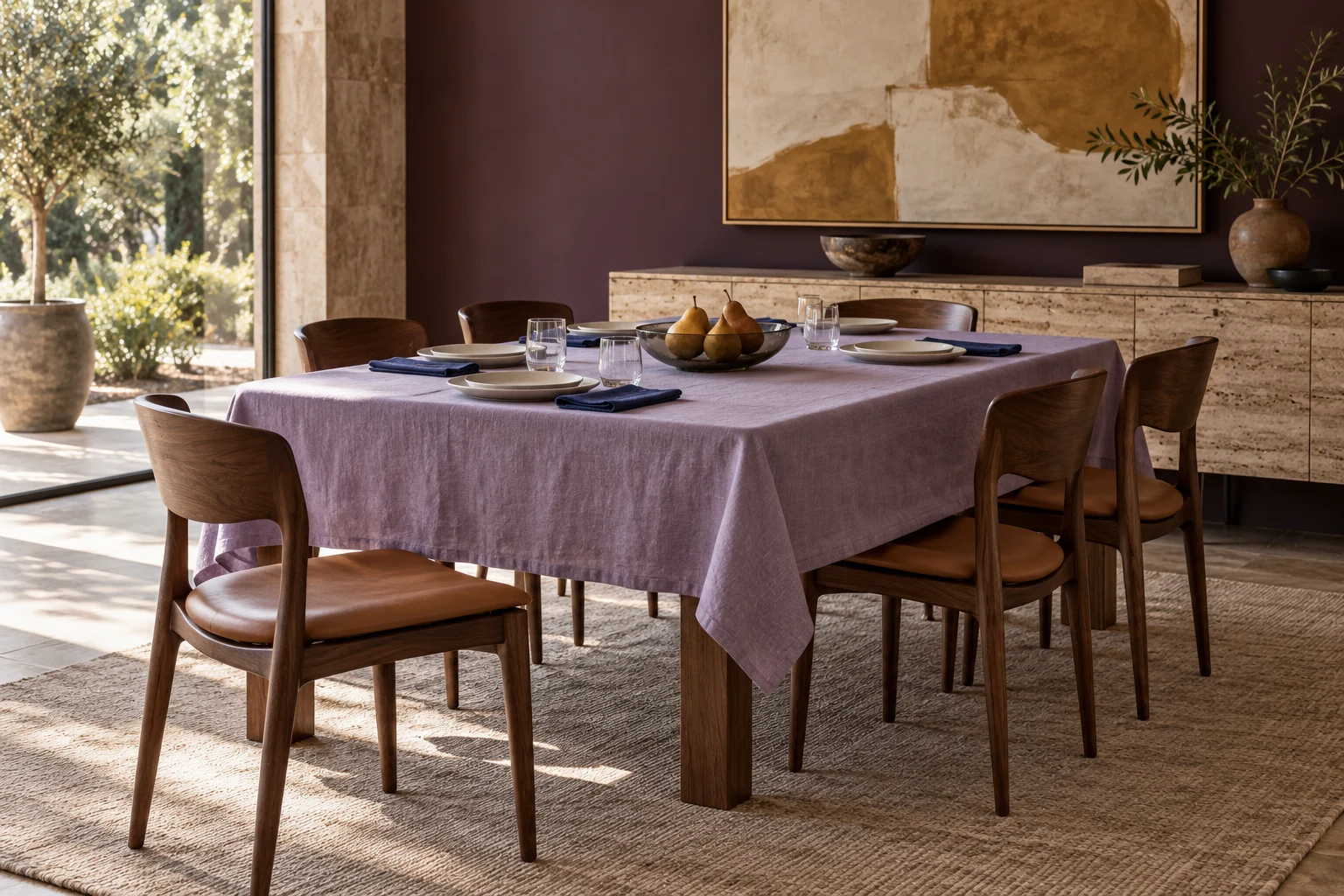
Start for free
The problem is often an untested edge, rather than an unattractive textile. A long drop can look graceful in an empty-room photograph, then collect on a seated person’s lap or catch as they leave. A very short drop may expose a table apron you wanted to cover. Decide which compromise matters in your room.
SFERRA’s size guide suggests 6-8 inches for a casual drop and 10-12 inches or more for a formal setting, and recommends visualizing the drop with a sheet. I treat those as styling starting points. Your seated trial decides whether a particular length is comfortable.
01 / One cloth, two answers
For a centered rectangular cloth, subtract the tabletop dimension from the corresponding cloth dimension, then divide by two. Use the same units throughout.
To work forward from a preferred drop, add twice that drop to each tabletop dimension. A 10-inch drop on an 84-by-40-inch table calls for a finished 104-by-60-inch cloth.
Imagine an 84-by-40-inch table and two possible finished cloth sizes. These are arithmetic examples, not claims that a particular merchant sells either cloth.
Candidate A / 108 × 70 inches
(108 - 84) ÷ 2 = 12
(70 - 40) ÷ 2 = 15
The length may look right while the sides feel too full. Rehearse the 15-inch side drop before ordering.
Candidate B / 104 × 60 inches
(104 - 84) ÷ 2 = 10
(60 - 40) ÷ 2 = 10
This meets the example’s equal-drop brief, but it may require a different stock size or a quoted alteration.
If a 24-inch leaf extends this table to 108 inches, Candidate A has zero end drop. It has not become defective; the table has changed. Label stored linens by the table configuration they fit, rather than only by a guest count.
02 / Keep, adapt or change the brief
A cloth that is barely large enough before washing deserves another check. SFERRA’s care guidance notes that natural fibers shrink and that many of its products include an allowance. Do not assume every brand uses the same allowance or that a listed size is a guaranteed post-wash measurement.
Ask whether dimensions are before or after laundering, whether a shrinkage allowance is included, and what drying method is required. Follow the exact care label. If you plan to alter a cloth, agree the laundering and final-size sequence with the person doing the work before it is cut. A convenient machine wash is less convenient if you have nowhere to dry the cloth as instructed.
Try a muted lavender cloth against walnut, then repeat a deeper blue only in the napkins. Keep the centerpiece low and the plates simple so the uninterrupted hem reads as one calm band around the room. Re-create the relationship with colors already in your cupboard before buying a coordinated set. The contrast comes from the large textile plane and one smaller echo.
03 / Two specification examples
These are ordinary merchant links selected to show different dimensions and care requirements. I have not tested these cloths, and this is not a paid placement. Specifications checked October 29, 2026; confirm the selected size, current price, returns and delivery availability with the retailer.
The US listing specifies 57 × 94 inches, 90% cotton and 10% jute, maximum shrinkage of 4%, and no tumble drying. On the illustrative 84 × 40 table, its listed dimensions give 5-inch end drops and 8.5-inch side drops before any size change.
Useful when: a shorter drop suits your trial and you can follow the drying instructions. It does not meet the example’s equal 10-inch brief.
Read the exact NISSÖGA listing →The listing describes printed 100% linen with a plain hem and offers a 70 × 108-inch size among its options. It specifies a cold gentle wash, with line drying or low tumble drying. On the same example table, the listed 70 × 108 dimensions create 15-inch sides and 12-inch ends.
Useful when: you prefer a fuller drape and the seated trial supports it. The wider fabric does not solve a side-drop problem.
Compare Abruzzo sizes and care →For a round cloth on a round table, subtract the table diameter from the cloth diameter and divide by two. For an oval table, measure both full axes and check the cloth’s shape; equal centerline calculations do not guarantee identical hanging folds around every curve. A square cloth on a round table deliberately creates longer corners. Test those corners too.
A buffet, a floor-length event cloth and a seated family dinner have different needs. This guide prioritizes seated home dining. It does not establish an accessible clearance standard, prove stain resistance or make fabric a heat barrier. Follow your tabletop maker’s protection guidance and use appropriate trivets for hot serving pieces.
Reviewed October 29, 2026. Calculations, seated trial, decision sequence and styling proposal are editorial applications; no hands-on product testing is claimed.
Read my editorial standards. Relevant home brands can find the publication’s collaboration information.